The 34th session of the trial of 104 members of the Mujahedin-e Khalq Organization (MEK) and its legal nature was held on Tuesday, May 26, in Branch 11 of the Tehran Province Criminal Court, presided over by Judge Hojjatoleslam al-Muslimin Amirreza Dehghani. In this publicly held session, attended by the prosecutor's representative, families of the martyrs, their lawyers, and the defendants' lawyers, Judge Dehghani emphasized the "principle of extraditing the Hypocrites" as a legal duty of
Martyr Jom'eh Sheikhi was born in 1954 in Dehloran County, Ilam Province. He lost his mother during childhood and worked alongside his honorable father to support the family, engaging in farming from a young age. In 1979, when the Iranian people's revolutionary spirit reached its peak, he joined the masses in rising up against the hated Pahlavi regime.
Following the victory of the Islamic Revolution, and during the period when the Dehloran Gendarmerie was vacated, he voluntarily served at
Kobra Mohammadpour was born on March 21, 1946, in the city of Sanandaj, Kurdistan Province. Her mother was a housewife, and her father was self-employed. Due to the lack of educational facilities and the cultural conditions of the time, she was unable to pursue formal education and instead devoted herself to managing her household.
In her youth, she married Ahmad Bani Bashar, and together they had five children—three sons and two daughters. Kobra Mohammadpour was always a devoted wife and a
Among the 23,000 victims of terrorism in Iran, there are numerous families that were entirely or mostly wiped out by terrorist groups, leaving their households shattered at the very core.
On the occasion of May 15, the International Day of Families, we have highlighted just a few of these families in this infographic as a small representation of the immense suffering endured.
The 33rd session of the trial of 104 members of the Mujahedin-e Khalq Organization (MEK) and its legal entity was held on Tuesday, May 12, in Branch 11 of the Tehran Province Criminal Court, presided over by Judge Hojjatoleslam Amirreza Dehghani. In this session, attended by the prosecutor's representative, families of the martyrs, their lawyers, and the defendants' lawyers, the main charge was identified as "terrorist acts."
At the beginning of the session, Judge Dehghani emphasized the
Hojjatoleslam Mohammad Hossein Fakhr Bonab, was born on June 26, 1938, in the city of Bonab, East Azerbaijan Province, into a religious family. After completing preliminary Islamic studies, he entered the Talebieh Seminary in Tabriz and later the Qom Seminary. Following years of study under esteemed scholars and completing advanced courses in Islamic jurisprudence and principles, he returned to his hometown and began preaching the radiant teachings of Islam in the cities of Maragheh and Bonab.
He was born on December 12, 1931, in the village of Marom, a district of Bandar Abbas. His father, Lotfali, was a laborer. Gholamabbas learned to read, write, and recite the Qur’an. In 1959, he got married and had one son and four daughters.
In defense of the Islamic Revolution and its values, he served as a member of the Islamic Revolutionary Committee.
On April 17, 1985, in Bandar Abbas, he was assassinated by members of the Mujahedin-e Khalq (MEK) terrorist group. He was killed after being
Martyr Mohammad Ghanbarian, a defender of the holy shrines, was born on April 25, 1971, in Shahroud, Semnan Province. Two of his brothers, Ahmad and Mahmoud Ghanbarian, were martyred in 1979 and 1982, respectively.
Mohammad was raised in a devout and martyr-nurturing family. After completing high school, he began working at the Saderat Bank branch in Semnan. In 2014, when he learned that enemies were threatening the holy shrines of Hazrat-e Zaynab (peace be upon her) and Hazrat-e Ruqayya
Javad Salahi was born on June 25, 1976, in the city of Osku, located in East Azerbaijan Province. He was a second-grade elementary school student. Alongside his studies, he helped his father with livestock farming.
On the evening of April 14, 1985, around 6:00 p.m., he was assassinated near his family’s home, located behind the public Khatib cemetery on Rah Ahan Street in Tabriz, when a handmade bomb planted by members of the Mojahedin-e Khalq (MEK) terrorist group exploded.
Nasser Seraj, an Iranian judiciary official, emphasized the necessity of enhanced counterterrorism efforts and legal cooperation during meetings with Iraqi judicial officials in Baghdad.
Tehran, IRNA – Deputy for International Affairs of Iran’s Judiciary and Secretary of Iran’s High Council for Human Rights Nasser Seraj has emphasized the need for a strong and decisive fight against terrorism and terrorist activities during a meeting with high-ranking Iraqi judicial officials.
During his
The 32nd session of the trial of 104 members of the Mujahedin-e Khalq Organization (MEK) and its legal entity was held on Tuesday, April 28, in Branch 11 of the Tehran Province Criminal Court. Judge Hojjatoleslam Amirreza Dehghani began the session by offering condolences for the incident at Shahid Rajaei Port, stating that the assassination of human resources targets the most important source of a country's soft power and emphasizing the necessity of an international fight against terrorism.
Seyyed Ali Akbar Shiraziha was born on July 23, 1949, in Varamin, Iran. He completed his education up to the third year of middle school, after which he took up shoemaking to help support his family. He later married and had two sons and four daughters.
Before the Islamic Revolution, he actively opposed the corrupt Pahlavi regime and played a role in encouraging people to participate in anti-regime demonstrations.
Following the victory of the Islamic Revolution, he responded to the call of
The Netherlands has long claimed to defend human rights and combat terrorism, yet its practical support for Iranian terrorist and separatist groups exposes a glaring contradiction in these claims. Organizations such as the Mojahedin-e Khalq (MEK) and the Arab Struggle Movement for the Liberation of Ahvaz (ASMLA) operate openly on Dutch soil—despite their long history of violence and terrorism, including the bloodshed of thousands of Iranian civilians. Nevertheless, for decades, the Dutch
In a meeting on the sidelines of the 20th Conference of Chief Justices of Shanghai Cooperation Organization (SCO) member states held in Hangzhou, China, the head of Iran’s Judiciary discussed the Islamic Republic’s position on legal and judicial cooperation, counter-terrorism, sanctions, and the use of emerging technologies such as artificial intelligence.
Speaking to Chinese media outlets CGTN, China Daily, and Xinhua, he highlighted Iran’s long-standing struggle against terrorism, noting
Over the past four decades, terrorists have taken the lives of more than 23,000 innocent people in the Islamic Republic of Iran.
Hojjatoleslam Mohseni Eje’i, Chief Justice of the Islamic Republic of Iran, delivered a speech today on Wednesday, April 23 at the opening ceremony of the 20th Meeting of Chief Justices of the Shanghai Cooperation Organization (SCO) member states, held in Hangzhou, China.
In his remarks, Iran’s top judicial official stated:
“Terrorism and the actions of terrorist
The wife of Martyr Masoud Ali-Mohammadi stated that the assassination of scientists is a clear violation of Iran’s right to development and that terrorism is a major obstacle to the country’s scientific progress.
Mansoureh Karami, wife of the assassinated nuclear physicist Masoud Ali-Mohammadi, spoke at the international conference titled "The Draft Comprehensive Convention on International Terrorism: 25 Years On", held at Allameh Tabataba’i University. In her address on the role of terrorism
The 31st session of the trial of 104 members of the Mujahedin-e Khalq Organization (MEK, also known as the Hypocrites) and the legal entity of the organization was held on Tuesday, April 15, in Branch 11 of the Tehran Province Criminal Court.
During the session, the plaintiffs' lawyer, Hojjatoleslam Masoud Maddah, citing internal documents and confessions, emphasized the terrorist nature of the MEK. He referenced Masoud Rajavi's negotiations with the head of the Iraqi intelligence service, in
The terrorist group Jaish ul-Adl has claimed responsibility for the assault on a patrol unit from Police Station 12 in Iranshahr.
According to the report, last night the Sistan and Baluchestan Police Information Center announced that following an emergency call to Police-110, as officers from Station 12 were dispatched to the location, armed assailants opened fire on them and fled the scene. A security operation was immediately launched to pursue the attackers.
Tragically, one of the patrol
In response to the Italian Parliament’s support for an anti-Iranian terrorist group and its decision to award a prize to one of its members, the families of Iranian victims of terrorism have issued an open letter addressed to the Italian Parliament and its authorities, protesting this deplorable action. The letter reads as follows:
The news that the Italian Parliament has chosen to present the so-called “Women of Courage Award 2025” award to a member of the Mujahedin-e Khalq (MEK) terrorist
The 30th session of the trial addressing the crimes of the terrorist group Mujahedin-e Khalq (MEK) prominently featured harrowing accounts of child soldiers and their bleak, suffering-filled lives.
The clock had just passed 8:30 AM, marking the start of the hearing. Latecomers hurried into Tehran’s Imam Khomeini Judicial Complex as proceedings began. Like previous sessions, this final hearing of the year 2024 drew significant media attention, with attendees listening intently as a dark chapter

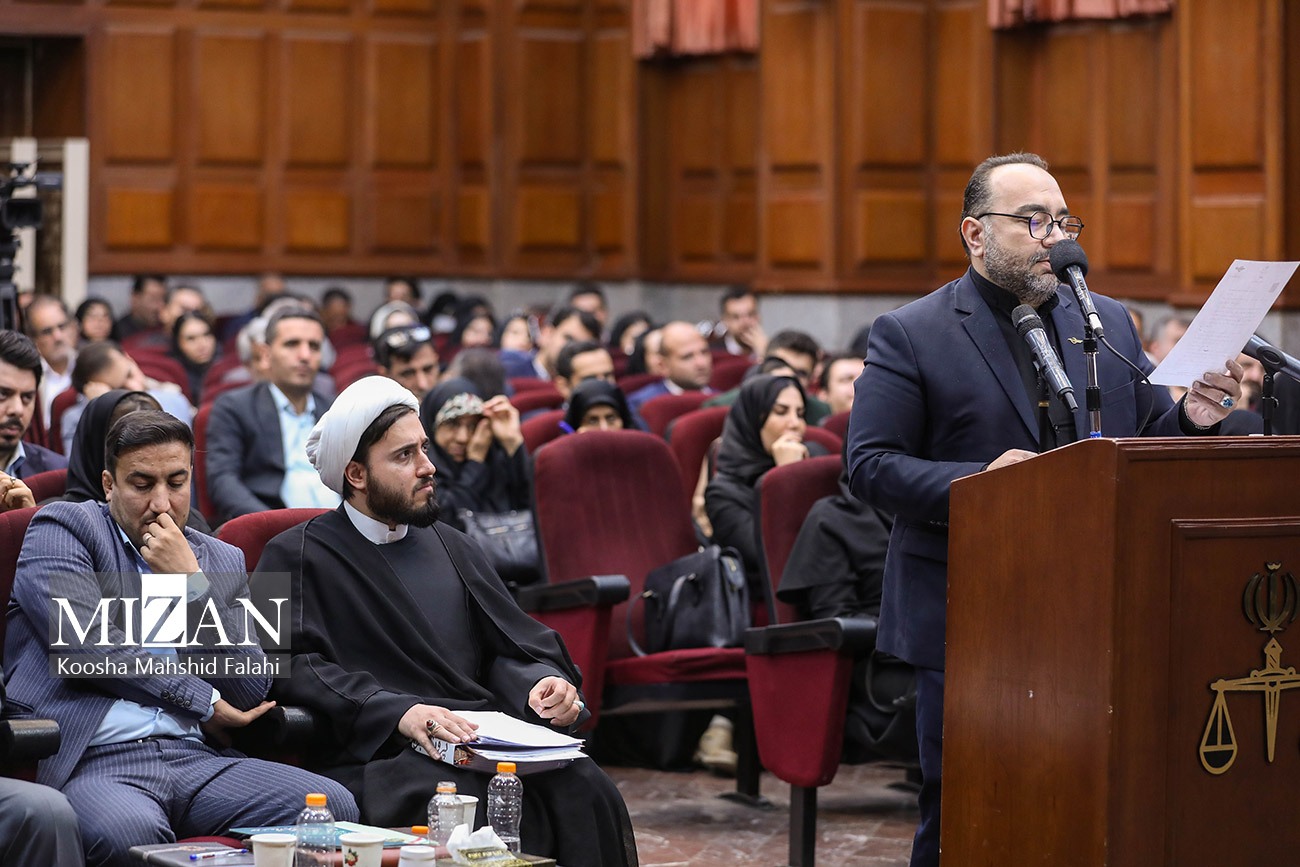 The 34th session of the trial of 104 members of the Mujahedin-e Khalq Organization (MEK) and its legal nature was held on Tuesday, May 26, in Branch 11 of the Tehran Province Criminal Court, presided over by Judge Hojjatoleslam al-Muslimin Amirreza Dehghani. In this publicly held session, attended by the prosecutor's representative, families of the martyrs, their lawyers, and the defendants' lawyers, Judge Dehghani emphasized the "principle of extraditing the Hypocrites" as a legal duty of


