
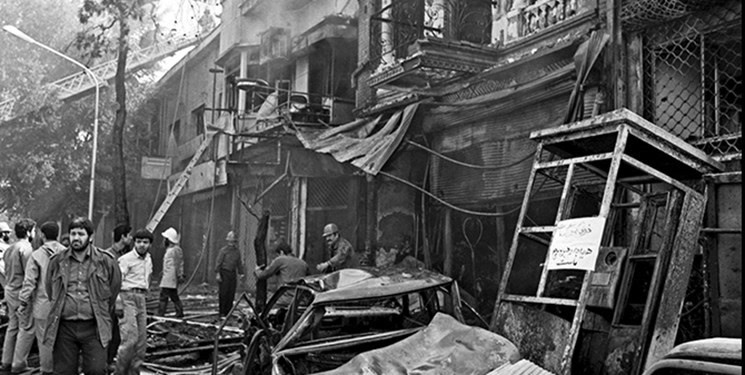
 On May 12, 1985, a bomb exploded on Naser Khosrow Street in Tehran, unleashing a horrifying and tragic event. Nine people were martyred and 45 others wounded. The people of Tehran were grief-stricken, but hardly shocked—in those years, bombings in the capital had become a grimly familiar occurrence.
There was a time when a bombing in Tehran was nothing out of the ordinary; it happened from time to time. Who was planting these bombs? The Mujahedin-e-Khalq (MEK) and counter-revolutionary elements—those who shared neither the people's sentiment nor their cause. What was their objective? To sow insecurity in the heart of the capital.
It was a desperate effort, intended mostly to make noise and grab attention. But at the end of the day, it was an attack that claimed lives—bitter and damaging to the people's Revolution. The years 1981 and 1982 marked the peak of the MEK's assassination campaigns. They carried out targeted killings aimed at revolutionary officials and key figures—claiming the likes of Rajai and Bahonar from among the people. They also engaged in indiscriminate terror, such as bombings that killed ordinary citizens—including attacks in 1981 at Eshratabad Square in Tehran, in 1982 at Imam Khomeini Square and Khayyam Street, and in 1984 at Railway Square. In that same year, the MEK carried out 22 terrorist operations in Tehran Province alone, and until 1986, they conducted at least 10 terrorist operations annually just in Tehran. The people of Iran have a long and painful history with these hypocrites and counter-revolutionaries.
Bombings to Settle Internal Disputes! After 1981, the MEK's capacity for terrorist operations diminished, but to prove they were still relevant, they occasionally planted bombs in major cities, particularly Tehran. Historical documents also reveal that some of these futile yet bloody operations were meant to justify internal conflicts within the organization—serving, in reality, an intra-organizational function.
According to Ali-Akbar Rastgo, writing in the book The Mujahedin-e-Khalq in the Mirror of History: "For over three years, the strategy of armed struggle in urban areas had reached a dead end. The goal of swiftly overthrowing the Islamic government had likewise been called into question. Urban operations had dwindled to zero; teams dispatched from Kurdistan to the cities—especially Tehran—were exposed, arrested, or eliminated before even reaching their mission sites. Members no longer accepted the organization's analyses of Iran's internal situation."
"This questioning of the organization's strategy had created internal tensions." Now, what of the fateful day on Naser Khosrow Street? The bomb—packed with 23 kilograms of TNT—was placed inside a Paykan car. It was around 8:00 a.m. on the busy thoroughfare. A two-story building and a clothing workshop were destroyed and consumed by fire; 15 vehicles and a bus were wrecked and burned; 25 shops were damaged and set ablaze; nine people were martyred and 45 wounded—all consumed in the fire of hypocrisy. What became of the hypocrites who planted that bomb?
They did not go unpunished. According to a report by Kayhan newspaper two days after the incident, security officials stated: "A total of two MEK operational units were dismantled. In one team, six members were arrested and two neutralized; in the other team, four were arrested."
"The weapons and ammunition seized from these operations included 14 grenades, four handguns, G3 and Uzi rifles, large quantities of explosives, and an RPG-7 launcher that was intended to be used against the Islamic Republic News Agency. Simultaneously, 26 safe houses and six front businesses belonging to the hypocrites' network were discovered in various provinces across the country, with a number of arrests made in connection."
Following this incident, MEK operations in the cities and the capital declined. The Iranian Revolution's red line was the security of the people, and it is well-known that in those years, Iran's military and security forces searched alley by alley and house to house for terrorists. From 1986 onward, the MEK withdrew from urban areas—they headed to the frontlines. They had gathered in Iraq, receiving military training and dreaming of a military takeover of Tehran within 48 hours. In the end, 1988 brought Operation Mersad—and that was the end of that.
By Amin Rahimi