
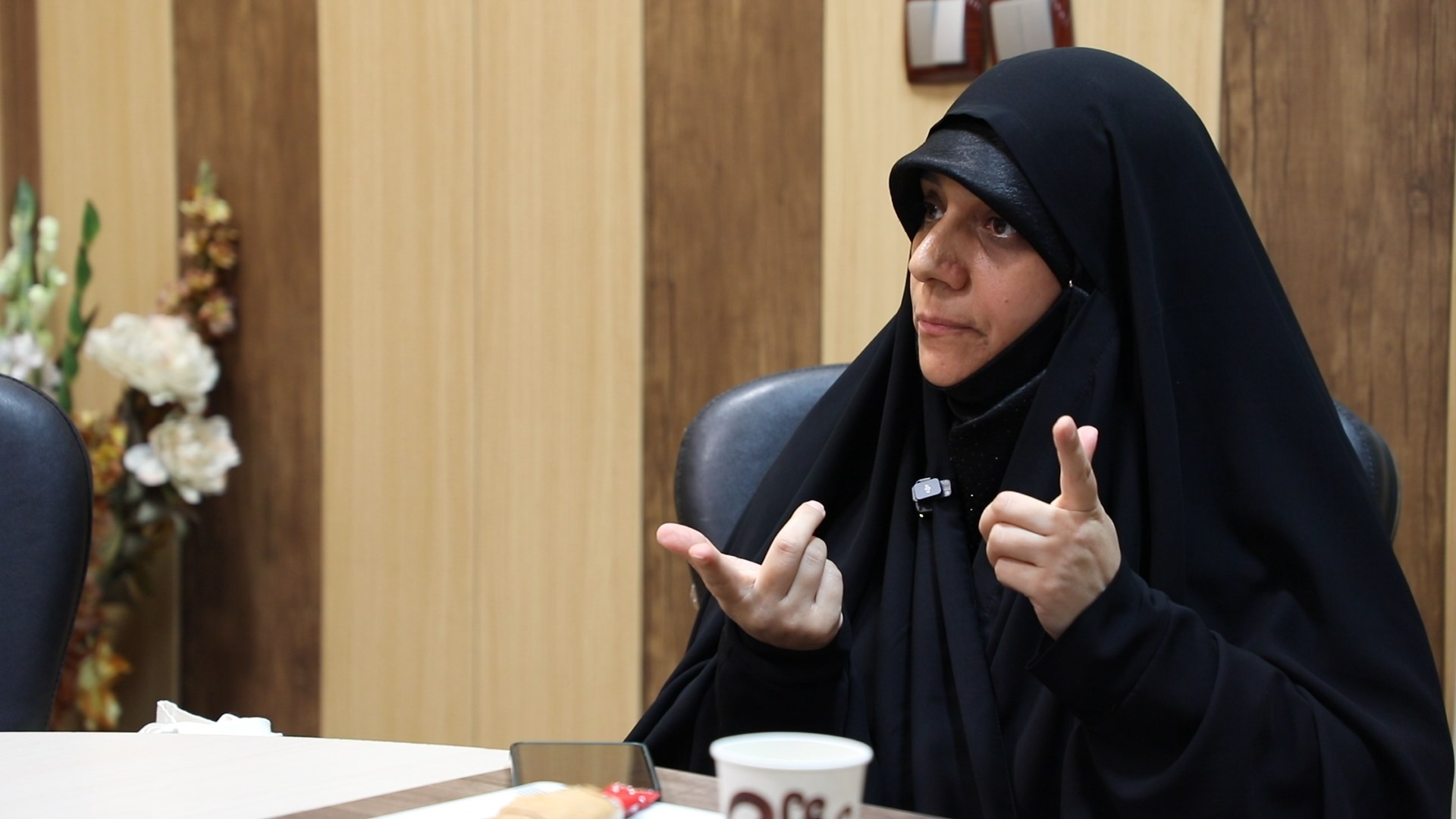
 At the “Children in the Crossfire of Aggression” roundtable, Ms. Misbah, widow of Martyr Hojatoleslam Ahad Aghdasi and mother of Martyrs Mohaddeseh and Mohammadreza Aghdasi, spoke about her painful experience in the June 13 terrorist attack. Living on the ninth floor of a 14-story building, she was rescued from heavy rubble without any apparent injury. She described how a strong foundation of faith and deep religious upbringing sustained her through those terrifying moments — from her prayer at dawn on the day of the attack to the support of a neighbor who gripped her shoulder and said, “Ms. Misbah, you have to stay strong.”
Ms. Misbah began by describing the moments after the explosion. The building had 14 stories, she said, and her family lived on the ninth floor. After the powerful blast, she was brought out of the rubble, by God’s will, without any visible injury. She was 43 when the incident occurred and attributed her response to a deep religious upbringing inherited from her father’s family and her ancestors — an upbringing rooted in belief in the principles of the Islamic Republic and in a relatively sound understanding of Imam Khomeini’s ideals.
Ms. Misbah explained that she offered this background because, within the first hour after emerging from the rubble, she asked God that if her loved ones were to be martyred or left disabled, she would say nothing contrary to God’s will, contrary to the interests of Islam, the Revolution and her country, or unworthy of the martyrs — particularly Hajj Agha Aghdasi. She described this as the first request she made of God in those critical moments.
She then described a second scene: a father and mother sitting on chairs, their faces filled with grief, yet firm and composed, without displaying any overwhelming emotional reaction. The wife of Martyr Engineer Khaki and mother of Martyr Mohammad-Hossein Khaki, one of their good neighbors, saw her and immediately placed her hands firmly on Ms. Misbah’s shoulders. “Ms. Misbah, you have to be steadfast; you have to be strong,” she told her. Ms. Misbah stressed that whenever she recounts the episode, she can still feel the force of that energy, and that the words made her feel better in that very moment.
Pointing to the different ways people respond to catastrophe, Ms. Misbah spoke about the family of Martyr Zein, who lived on the 10th floor. The woman of that family was pulled from the rubble after five hours, while her husband and two daughters had been martyred. Ms. Misbah said there were differences between them in terms of religious belief, and that challenges faced by the other family had, in her own case, been resolved through the strength of her religious foundation.
She went on to describe her monotheistic outlook and recalled a sentence from lectures by Sheikh Hossein Ansarian that had touched her deeply: “Introduce children to a loving God — a God more compassionate than a father or mother, beyond all comparison.” The sentence sparked an idea for her. From then on, she addressed even the most complex questions of faith, including the philosophy of suffering in life, with her nine-year-old daughter through the language of God’s love. She said she could tell from the sparkle in her daughter’s eyes how much the approach comforted her.
Ms. Misbah also spoke about physical complications caused by the explosion. Although she had been pulled from deep inside the rubble of the stone building, she suffered internal bleeding. Her brain and cognitive faculties were not damaged, however, and she did not lose consciousness. She said she remembers everything clearly, from the moment of the explosion through the moments when the building’s walls and doors twisted together. After she emerged, she had to identify herself repeatedly because everyone thought she, too, had been martyred.
In closing, she stressed how important it is to have people nearby in such moments who can offer guidance and emotional support. With the help of those around her, she said, and by relying on the foundation of faith she had carried since childhood and her deep connection with Imam Hussein, she was able to pull herself together. The Imam’s conduct at Karbala, she added, continues to help her to this day.