
 When assassination turns a child's brain into a factory for producing fear, salvation lies in a relationship that transmits the message "This place is safe" directly to their nervous system.
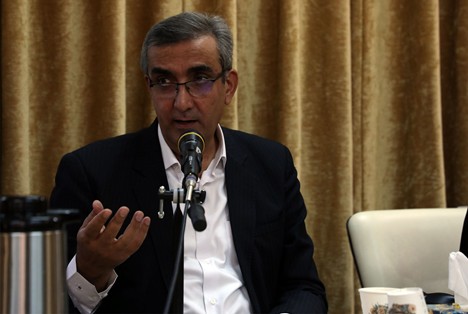
According to Habilian, at the specialized conference "Children in the Shadow of Terror" in cooperation with the Faculty of Educational Sciences and Psychology at Ferdowsi University of Mashhad, Dr. Seyed Amir Amin-Yazdi, a faculty member, criticized the mechanical view of the child victim and presented the theory of "active meaning-making." His analysis shows that terror "hacks" the brain's predictive system, forcing it into mass-producing catastrophic predictions; the path to salvation, however, lies through a "secure relationship" and the technique of "co-regulation."
Dr. Amin-Yazdi's speech began with rare scientific humility. He honestly noted the scarcity of specific research in the psychology of terror, forcing reliance on existing trauma frameworks. But this admission was merely a prelude to a more fundamental critique. He then criticized the common image of the child victim as a "reaction machine" or an automatic reflex, as if violence is input and disorder is output. Dr. Amin-Yazdi explained this view—a reflection of a modern, mechanistic perspective on humans—by comparing it to the "knee-jerk reflex": an involuntary reaction where the individual seemingly has no choice. He believes this view ignores the richness and complexity of the human psyche.
Against this reductionist view, he introduced a new framework: "the child as an active meaning-maker." Here, the child is not passive but actively constructs meaning from a catastrophic event. This idea, rooted in constructivist psychology, formed the cornerstone of his analysis. To clarify, Dr. Amin-Yazdi presented a simplified yet profound model of brain function: "The brain is a meaning-making predictive device." Its job isn't just reaction, but simulation, prediction, and interpretation of the world for survival. Based on past experiences, the brain builds a model of the world, predicts what will happen, creates "meaning" for events, and guides behavior.
The key question was: How does trauma from a horrific event like terror disable this intelligent system? He described a chain-like, devastating process. The first and most crucial step is the creation of a pathological "attentional bias." After a terror event, the child's mind acts like a faulty radar, seeing only threatening cues and ignoring millions of harmless stimuli. This bias is a malfunctioning, stuck survival strategy—a system activated for a crisis but now unable to shut down. This distorted data feeds the predictive system, whose database is now full of that horrific memory—no longer a mere recollection but a faulty predictive model for the future. The result is the production of "catastrophic predictions": "This sound means another attack." These predictions—not reality, but born of the faulty model—trigger floods of fear and anxiety, driving the child toward avoidance or defensive behaviors.
Dr. Amin-Yazdi emphasized the problem doesn't stop there. Repetition of this cycle gradually forms a fixed "pessimistic lens" or "black filter" in the child's mind. Seen through this lens, the world appears not just threatening but inherently unsafe, and the self as worthless and alone. This is an ontological transformation in the child's lived experience. Deeper still, this faulty system locks the brain's ability to correct its own predictive errors—the very mechanism for learning and hope for change. According to him, this locking signifies the death of "hope for change" within the neuro-psychological system, explaining why trauma is so persistent and tenacious.
Given this description of trauma's complex mental prison, where is the way out? Dr. Amin-Yazdi believed the answer lies in "rebuilding the predictive device." But this rebuilding isn't possible through mere words. The golden key is creating a "secure relationship"—one filled with trust, respect, and unconditional warmth, serving as an antidote to the violent relationship that caused the trauma. This relationship acts as a new, convincing information source for the faulty predictive device. Within this secure relationship, the vital technique of "co-regulation" gains meaning. He beautifully described this neuro-social technique: the adult (parent, therapist), with their calm nervous system, helps extinguish the fire of the child's dysregulated nervous system, like a firefighter. This process transfers regulatory capacity from outside to inside the system, with the ultimate goal of rebuilding the child's "self-regulation" ability. This transfer of calm happens through non-verbal means: a safe embrace, a kind, non-judgmental gaze, a calm tone of voice, a confident presence. These behaviors transmit the message "This place is safe" directly to the child's brain.
In his conclusion, he emphasized a principle rooted in an ethical-pragmatic insight: "The higher the anxiety and anger rise, the more security is the antidote." As long as the child is in a state of "neural freezing" due to fear, offering logical arguments is not only useless but can be violent. The child must first experience security within a human relationship. Creating this secure relationship is the "first brick of change" and the essential foundation for any other therapeutic intervention.
Dr. Amin-Yazdi's speech opened a new window into understanding the suffering of children victimized by terror. His analysis showed the damage is not just a chemical reaction but an active process of constructing a meaningful world that traps the individual. In this view, the path to salvation also passes through the same gate: re-meaning-making, under the shelter of a human, secure relationship. This framework reveals both the depth of the tragedy and draws a hopeful, tangible path for providing help.