
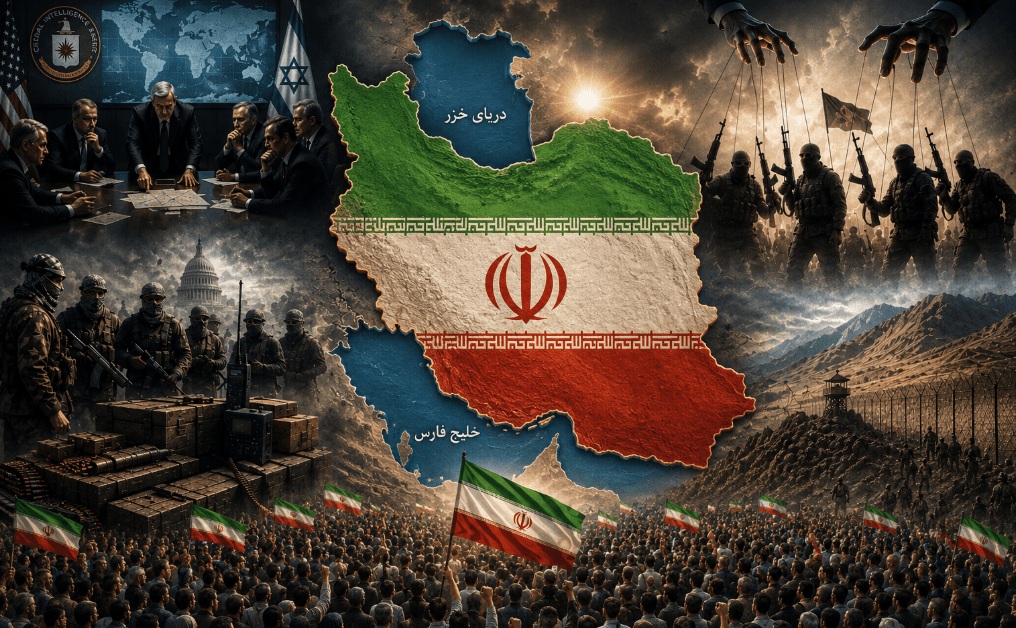
 Iranian analysts have long argued that proposals to fragment Iran along ethnic and regional lines have featured in strategic discussions in the United States and Israel as a means of weakening the Islamic Republic.
According to this interpretation, the latest conflict marked an attempt to move such concepts from strategic planning into practice, with armed separatist groups allegedly being used to create instability inside the country.
The argument is that partitioning Iran has for years been discussed within certain U.S. and Israeli strategic circles and that, with the outbreak of the recent war, armed and separatist organizations were again considered potential instruments for pressuring Tehran.
Iranian officials and commentators say the effort ultimately failed because of domestic cohesion and the response of the country’s security and military forces.
The article points to the book Regime Change, attributed here to New York Times journalists Maggie Haberman and Jonathan Swan, as discussing U.S. planning toward Iran.
According to the account presented in the report, one scenario allegedly involved using armed separatist groups to enter Iran through its western borders at the same time as military strikes were under way.
The article places this alleged strategy within the broader debate over a so-called “New Middle East.”
Former U.S. Secretary of State Condoleezza Rice used the phrase “birth pangs of a new Middle East” during the 2006 Lebanon War, language that later became the subject of extensive debate in the region.
Iranian critics have interpreted the concept as part of a broader strategy aimed at weakening major regional states by intensifying ethnic, sectarian and political divisions.
The article also refers to earlier writings attributed to Israeli strategic thinkers advocating the fragmentation of Middle Eastern states into smaller ethnic or sectarian entities.
Within this interpretation, Iran is viewed as one of the countries potentially affected by such thinking.
According to the report, U.S. and Israeli planners sought during the latest conflict to encourage coordination among armed separatist organizations by providing weapons, communications equipment, explosives and financial support.
Some sources cited in the article claimed that the groups were expected to enter Iranian territory within 72 hours of the start of military attacks.
Reports have also alleged contacts between the CIA and several Kurdish armed organizations, as well as contacts between Donald Trump and Kurdish political figures in the region before the war.
The article further cites later remarks by Trump concerning support for Iranian protesters as additional evidence, in its interpretation, of a coordinated effort to generate domestic instability.
These claims, however, remain politically contested and would require independent corroboration to establish the nature and extent of any operational coordination.
According to the Iranian account, the anticipated scenario did not materialize. Instead of widespread internal fragmentation, communities across different ethnic and political backgrounds largely rallied around the defense of Iran’s territorial integrity.
At the same time, Iranian intelligence and military forces reportedly targeted logistical facilities and bases belonging to armed groups beyond the country’s borders, limiting their ability to mount organized cross-border operations.
The result, according to the report, was the failure of the infiltration strategy. None of the armed groups succeeded in seizing Iranian territory, and an alleged plan to create a corridor of instability stretching from the northwest to the southeast failed to take shape.
The article argues that, after failing to achieve their objectives during the conflict, separatist armed groups have continued to carry out attacks against civilians and infrastructure in border regions in an effort to demonstrate their usefulness to foreign supporters.
Iranian authorities regard such attacks as part of a longer pattern of external attempts to exploit armed opposition groups against the country.
From this perspective, the recent war reinforced Tehran’s longstanding argument that fragmentation is not merely a theoretical political scenario but a recurring element in strategies aimed at weakening the Islamic Republic.
Iranian officials maintain that national cohesion, cooperation among the country’s different ethnic communities and the capacity of the armed forces prevented the strategy from succeeding.
The broader message advanced by the article is that Iran’s territorial integrity remains a powerful point of national consensus and that attempts to exploit ethnic divisions are unlikely to succeed without significant support from within Iranian society.
By Kamran Shirazi