
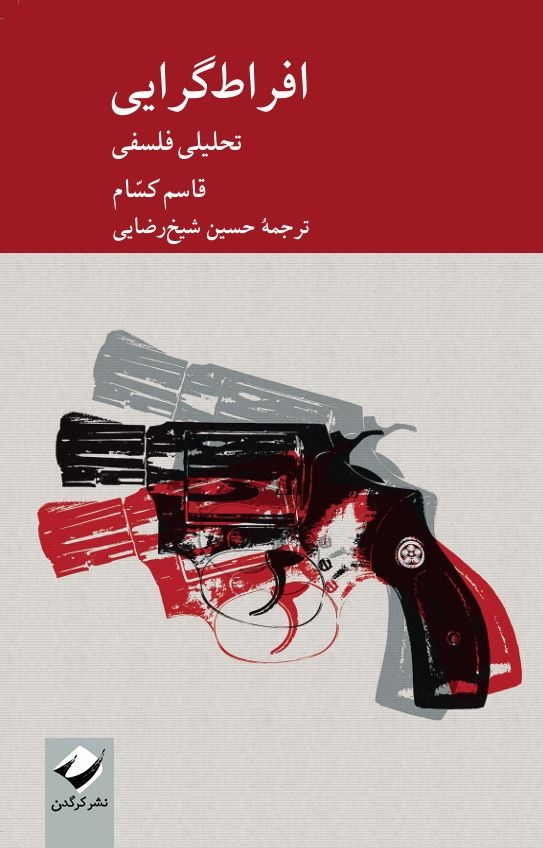
On the occasion of the International Day for the Prevention of Violent Extremism as and when Conducive to Terrorism, Extremism: A Philosophical Analysis by Quassim Cassam—recently published in Persian translation by Hossein Sheikh-Rezaei through Kargadan Press—stands out as a thought-provoking contribution. Moving beyond conventional political and psychological analyses, the book adopts a philosophical lens to examine the epistemic and moral roots of extremism.
What distinguishes Cassam’s work is its focus on the “extremist mindset” as a psychological pattern independent of specific ideological content. As Sheikh-Rezaei explains, Cassam argues that what defines an extremist is not necessarily what they believe, but how they believe it. The extremist mind is closed to external evidence, resistant to revising its convictions, and entrenched in exclusionary binaries that foreclose meaningful dialogue with others. In this account, extremism is less about what one thinks and more about how one thinks.
In an interview with IBNA, the translator described his motivation for bringing the book into Persian as rooted in what he sees as a threefold manifestation of extremism in Iran’s socio-political landscape: within the governing establishment, within opposition movements, and—perhaps most pervasively—across social media platforms, where identities are increasingly defined by the negation of the “other.” In such an environment, the book offers a conceptual framework for distinguishing extremism from neighboring concepts such as radicalism. Drawing a contrast between Gandhi and a terrorist, Cassam shows that while radicals may seek fundamental change, they do not inherently embrace violence. Extremists, by contrast, are characterized by dogmatism, cognitive rigidity, and a readiness to resort to violence.
Another noteworthy dimension of the book is Cassam’s critique of counter-extremism programs. He regards the United Kingdom’s “Prevent” strategy as flawed, arguing that its top-down approach and its portrayal of extremists as passive patients undermine its effectiveness. By contrast, he views Saudi Arabia’s model as comparatively more successful, citing its efforts to engage individuals within their own intellectual and religious frameworks and through authorities they recognize as legitimate.
At the same time, Sheikh-Rezaei raises a significant criticism of Cassam’s thesis: the philosopher may place too much emphasis on individual psychology while overlooking group dynamics. In some collective settings, he notes, not every individual may exhibit extremist traits, yet the group’s overall behavior can still result in violence and exclusion.
On the International Day for the Prevention of Violent Extremism, this book serves as a reminder that the roots of terrorism may lie less in particular ideologies than in a form of cognitive and moral dysfunction. Its remedy, therefore, cannot be imposed by force, but must emerge through dialogue conducted in terms accessible to the closed mind. In this endeavor, philosophy functions as a compass—quiet yet precise—clarifying the boundaries between faith and fanaticism, resistance and terror, and radicalism and extremism.