
The day after the major crime and explosion that led to the martyrdom of 12 people and the wounding of 25 ordinary citizens and passersby in Sepah Square, Ettela'at newspaper reported: "A schoolgirl about ten years old whose hands and legs were severed in the explosion is among the martyrs." The newspaper published a photo of the girl's schoolbag and wrote: "The martyrs and wounded of the explosion in Eshratabad Square were, apart from a few IRGC members, a municipal street sweeper, a student, a bus passenger, and ordinary passersby—nothing else…"
According to Habilian, February 22, 1982 (3 Esfand 1360), was yet another act of revenge against innocent people, and innocent schoolchildren by an organization that claimed to represent the people. In the name of the people, it would gun down street sweepers, vegetable sellers, butchers, and neighborhood grocers; kidnap six-year-old children and return their bodies days later; rob banks; and blow up buses full of passengers—from housewives to elderly women and children in their mothers' arms—to "prove" its popular nature.
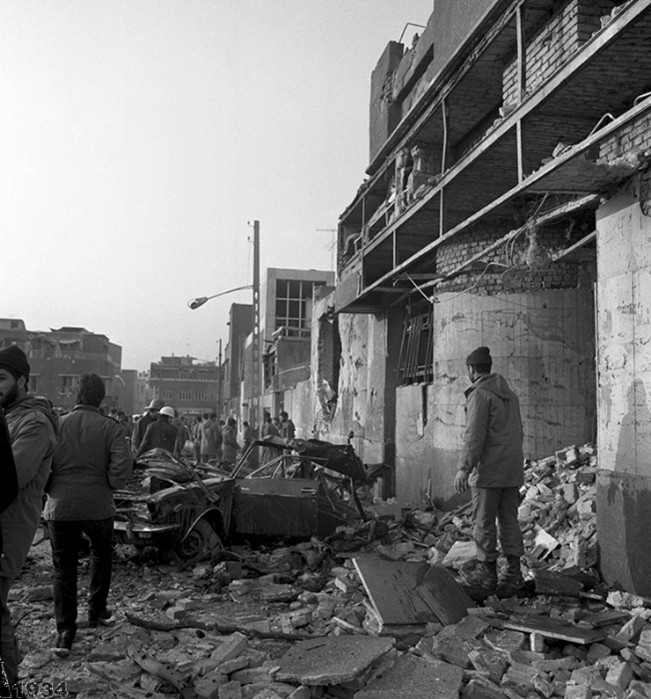
On that day, the MEK—desperate and disillusioned by the people's support for the Revolution and Imam, having suffered a devastating blow with the collapse of its central command and the death of its main leaders inside Iran and in the capital—lashed out like a wounded snake in a mad, criminal act in the heart of Tehran. In the busiest morning hours, when Sepah Square (Eshratabad) was filled with ordinary passersby, employees, and school students, they detonated a powerful bomb hidden under a municipal garbage truck, adding another shameful page to their black record.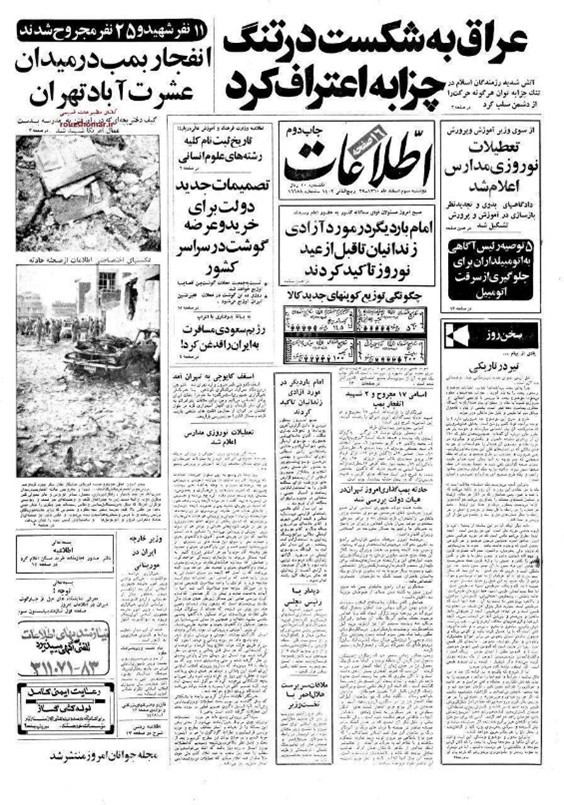
Ettela'at Newspaper's Report on Casualties and Damage
The day after the horrific MEK terrorist attack in Sepah (Eshratabad) Square in Tehran, Ettela'at reported: "As a result of the explosion of a very powerful bomb hidden under a municipal garbage truck, 11 to 12 people were martyred and 25 others injured. News of further martyrs has not yet been received. The power of the bomb was such that it caused destruction within a one-kilometer radius and inflicted heavy damage on more than eight passing vehicles and ten residential houses."
According to the Ettela'at reporter at the scene, at 7:16 a.m., while the people were heading to work as usual, a very powerful bomb—reportedly of the TNT type—exploded on Sepah Street opposite the United Company repair shop. Several people were martyred and others seriously injured.
But what was the reason for this crime on such a scale and with such dimensions? Why did the MEK take revenge for its political and historical defeat against the Islamic Republic on innocent people and guiltless children who were simply going to work or school that morning?
Defeat by the "System," Revenge on the "People"
From the day after it openly declared armed struggle against the Islamic Republic system on June 20, 1981 (30 Khordad 1360), creating waves of chaos, crisis, and political tension, and then beginning the assassination of high-ranking officials, Friday prayer leaders, judicial officials, and Majlis representatives—including the martyrdom of 72 of Imam's companions, led by Ayatollah Dr. Beheshti on June 28 (7 Tir), and the martyrdom of President Rajai and Prime Minister Bahonar on August 30 (8 Shahrivar)—the MEK terrorist group defined its policy in the "military phase" and "terrorist operations." From July 1981 (Tir 1360), the organization's policy, communicated to its supporters and members in safe houses, was the assassination of leaders in the hope that the system would suffer a vacuum and the absence of key managerial figures would cause the government to collapse.
After September 1981 (Mehr 1360) and the clear failure of this misguided policy—stemming from a lack of understanding of the nature of the Revolution and Imam Khomeini's leadership logic—the organization fell into frustration and passivity and adopted a policy of revenge against ordinary people in the streets and bazaar. They called it "striking the fingers of the system." Their justification to supporters was that they were striking the regime's mercenaries to create fear and stagnation in the heart of the government so that no one would dare stand by the system's banner. With the dispersal of the government's supporters, the system would gradually reach its end.
Thus, anyone with a beard or green jacket, anyone with a religious appearance, anyone who had hung a photo of Imam Khomeini, Beheshti, Khamenei, Rafsanjani, or Rajai in their shop was labeled a thug, mercenary, people-seller, and anti-people force and had to be summarily executed in the street as "revolutionary justice."
The MEK Turns to Massacring Ordinary People and Street Passersby
However, the assassination of people with appearances close to revolutionary and religious values eventually turned into indiscriminate mass murder and aimless terror against ordinary citizens. This policy emerged in parallel with the organization's defeats and passivity in the face of the Islamic Republic system's consolidation of power and popular support. Disconnected from the people, yet claiming to act in their name, the MEK tore the very people apart with bombs and TNT.
The failure of the MEK's armed demonstration on September 27, 1981 (5 Mehr 1360), and their disillusionment with popular support led them to resort to open massacre and unmasked terrorism. On October 17, 1981 (25 Mehr 1360), a bus full of passengers—mostly children and women—was set on fire by MEK members in Shiraz. Nearly 40 people were injured and suffered burns; two children burned alive. Another of the most horrific MEK crimes occurred on October 13, 1981 (21 Mehr 1360), with the martyrdom of a six-year-old child and his 22-year-old mother in Shiraz. According to Kayhan newspaper, at 7 p.m. that day, MEK agents planted a bomb in a Peykan car on Hedayat Street in Shiraz, martyring the two.
Background and Intensity of the February 22, 1982, Terrorist Operation
Why was the terrorist operation of February 22, 1982 (3 Esfand 1360), in terms of intensity, extent of destruction, number of casualties, and volume of explosives, far larger than all previous operations except the Sarcheshmeh incident and the explosion at the Islamic Republic Party headquarters on June 28 of the same year? Many of the martyrs were so torn apart and pulverized that identification was difficult. Images remaining from that day show that the bomb site created a large crater two meters deep into the ground.
The blow of February 8, 1982 (19 Bahman 1360)—the discovery and destruction of the organization's central safe house on Zafaraniyeh Street and the death of its leaders, including Mousa Khiabani (the organization's number two after Massoud Rajavi), his wife Azar Rezaei, Ashraf Rabiei (Massoud's wife), and other key figures who directed terrorist operations from inside the capital—shocked the organization so deeply that for a long time it did not know where or how it had been struck. This lightning strike by IRGC intelligence, prepared over months, was the first major and decisive blow to the organization's body.
After this action, in order to compensate for the defeat and restore confidence and motivation to its internal forces, the organization sought to create news and demonstrate its operational power and capability. But the people became the victims of this sinister and satanic strategy. The organization took revenge for its defeat against the system and Imam on innocent people in the streets and alleys.
The Severed Body of a Ten-Year-Old Schoolgirl
One eyewitness described the incident: "At the time of the explosion we were near the scene. Moments after the blast, we saw several cars on fire and several residential houses destroyed. When we went toward the sound of the explosion, we faced more than ten passersby whose bodies had been torn to pieces and scattered in the middle of the street and on the sidewalk. We immediately began collecting them with the help of IRGC members and local residents. In addition, we removed about eight bodies from inside several cars that had been caught in the explosion and transferred them to various hospitals. Also, a schoolgirl about ten years old whose hands and legs had been severed in the explosion was among the martyrs."
A Husband, Wife, and Young Child Burned Inside Their Car
One of the IRGC members present at the scene said: "I was driving a Peugeot through this street when suddenly I heard a massive explosion. The car windows shattered and I was thrown out. When I opened my eyes, I saw people burning inside several cars. We immediately helped residents pull some of the passengers out, but unfortunately a husband, wife, and young child inside a Peykan car were all martyred."
After this criminal incident, which displayed the depth of the MEK’s hatred for the revolutionary people, the people present at the scene—according to Ettela'at daily—held a spontaneous march an hour after the explosion and the martyrdom and wounding of dozens of innocent people. They raised the bloodied clothes remaining from the martyrs of the incident like flags, chanting slogans against enemies of the people and declaring that the blood of these oppressed martyrs would not be wasted.