
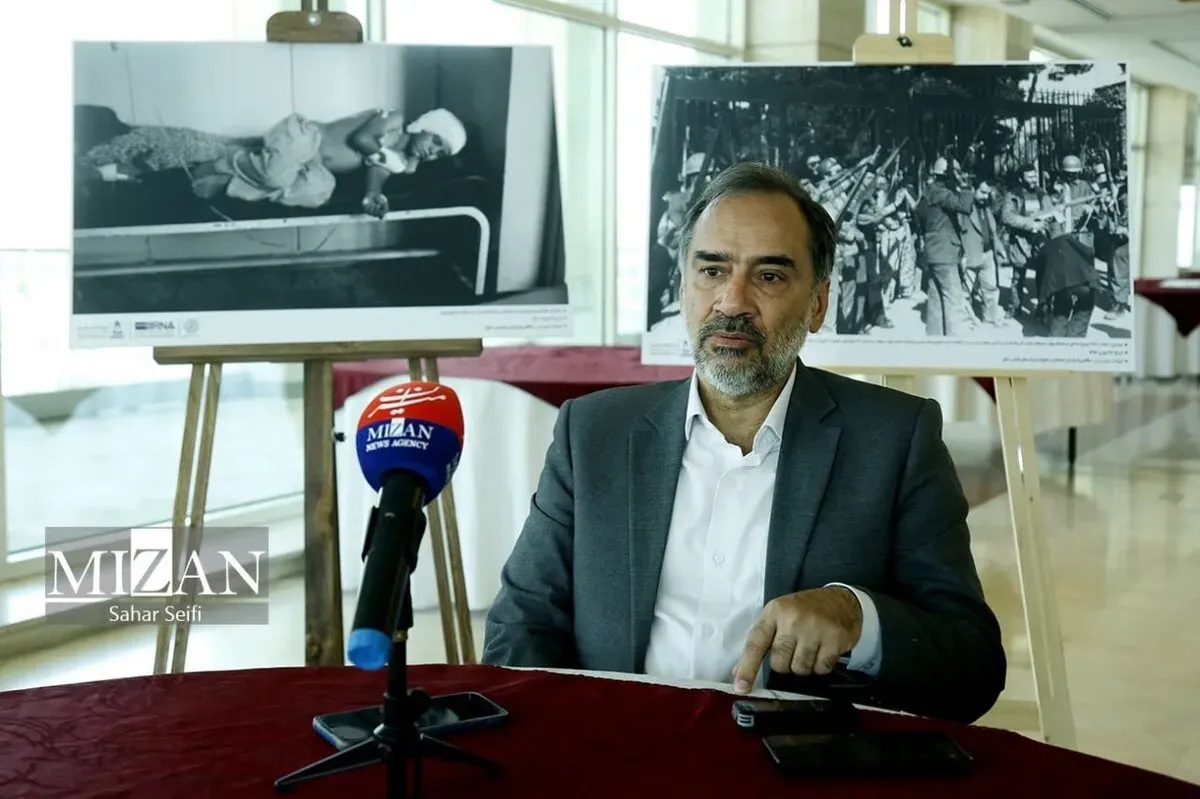
 The lesson of Operation Mersad is that Iran’s adversaries and the Mujahedin-e Khalq repeatedly enter confrontations based on miscalculations and unrealistic assumptions, only to face the determination of the Iranian people, Habilian Association Secretary-General Mohammad Javad Hasheminejad said.
Operation Mersad, fought between July 26 and July 30, 1988, was not only one of the final major episodes of the eight-year Iran-Iraq War but also a turning point in Iran’s confrontation with the MEK.
Marking the anniversary of the battle that ended the MEK’s Forough-e Javidan, or Eternal Light, offensive in western Iran, Mizan News Agency spoke with Seyyed Mohammad Javad Hasheminejad, secretary-general of the Habilian Association, an organization representing families of Iranian victims of terrorism.
In the interview, Hasheminejad discussed the historical background of the operation, allegations of crimes committed during the offensive, the MEK’s current status and ongoing legal proceedings against the organization.
Mizan: On the 38th anniversary of Operation Mersad, what was the historical context in which the MEK planned the offensive, and what was it seeking to achieve?
Hasheminejad: Operation Mersad, which the MEK called “Eternal Light,” represented the culmination of the organization’s cooperation with Saddam Hussein.
The offensive came after Iran had accepted UN Security Council Resolution 598. The assumption among Iran’s adversaries was that after eight years of war, the Islamic Republic and the Iranian population no longer had the capacity or willingness to defend the country. That proved to be a serious miscalculation.
With full support from Saddam Hussein’s government, the MEK crossed the border on July 25, 1988, with more than 5,000 personnel and heavy military equipment.
They promoted the slogan “From Mehran to Tehran in three days” and even expected people inside Iran to welcome them. Instead, they encountered resistance from the local population and Iranian forces.
Mizan: One of the darkest aspects of the offensive concerns allegations of atrocities in Islamabad-e Gharb. What happened there?
Hasheminejad: The crimes committed during the Eternal Light operation went far beyond what many people imagine.
After entering Islamabad-e Gharb, MEK forces opened fire on Imam Khomeini Hospital, killing wounded people, patients and medical staff. Bodies were gathered in the hospital courtyard and burned.
Women, children, bakers and even livestock farmers in the surrounding countryside were killed.
One fighter who was present during the operation later recounted that even a one-day-old infant was not spared.
These incidents, in our view, revealed the true nature of the organization.
Mizan: How do you assess the number of casualties in the operation?
Hasheminejad: Around 1,100 Iranian troops and civilians were killed during Operation Mersad.
According to available figures, including figures acknowledged by the MEK itself, more than 1,200 members of the organization were also killed, while a large quantity of heavy equipment—including 72 tanks and armored vehicles—was destroyed.
Mizan: Nearly four decades later, what message does Operation Mersad hold for Iranian society and for families of victims of terrorism? How does it relate to current developments such as the ongoing trial of the MEK?
Hasheminejad: The message of Mersad is that whenever Iran’s enemies or the MEK act on miscalculations and illusions, they ultimately encounter the determination of the Iranian people.
Just as the United States and Saddam Hussein miscalculated at the time, and as others have miscalculated since, the MEK suffered a decisive defeat at Mersad and learned that it had no meaningful social base in Iran.
Today, the families of approximately 23,000 Iranian victims of terrorism—the latest figure compiled by the Habilian Association—are seeking justice.
The ongoing court proceedings concerning alleged crimes committed by the MEK are an important step in responding to those longstanding demands.
The Mersad case forms an important part of those proceedings.
These trials demonstrate that alleged crimes do not simply disappear with the passage of time and that victims’ families continue to seek accountability.
We hope these legal efforts will ultimately result in the organization being held accountable through domestic and international legal mechanisms.