
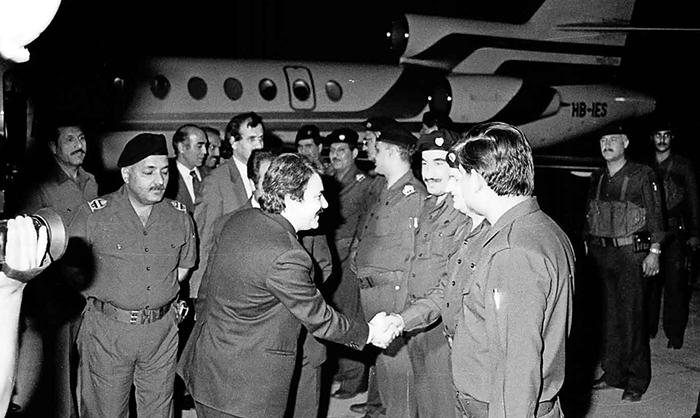
 On June 7, 1986, an airport on the outskirts of Paris witnessed the takeoff of an aircraft that marked one of the bloodiest and most treacherous chapters in contemporary Iranian history. As Massoud Rajavi, the leader of the terrorist Mojahedin-e-Khalq organization (MKO), also known as the Monafeqin (hypocrites), left France for Iraq, this move was dubbed a "historic flight" in the group's lexicon. In reality, it was the beginning of the final metamorphosis of a group claiming to fight for freedom into a mercenary cult serving an invading enemy. To understand why this transfer happened, its various dimensions must be examined.
Why Did France Abandon Rajavi?
Rajavi's presence in France since 1981 was based on an unwritten agreement to support groups opposing Iran. However, with the prolongation of the Iran-Iraq war and shifting power dynamics in Paris, the tables turned. In the mid-1980s, the French government faced numerous crises, the resolution of which lay within the framework of certain understandings with Tehran. The primary driver for expelling the MKO was the issue of French hostages in Lebanon. Lebanese resistance groups, with deep spiritual ties to Iran, had taken several French nationals captive, and their release was linked to the expulsion of the MKO.
Beyond the hostage crisis, significant financial matters were also at play. The Pahlavi regime had lent one billion dollars to the "Eurodif" uranium enrichment consortium, a debt Iran sought to recover with accrued interest after the revolution. France, which at the time had extensive trade relations with Iraq while also not wanting to lose the Iranian market entirely, engaged in a major political bargain. In this political give-and-take, Rajavi's departure from French soil became the key to unlocking Tehran-Paris relations. France even suggested third countries for Rajavi, but he, seeking a military path back to power, had only one destination in mind: Baghdad, right in the middle of the war and aggression against his homeland.
Dead-End in Paris and the Mirage of Victory in Baghdad
Historical data shows that residing in Europe had become a dead end for Rajavi. After the failure of the short-term overthrow strategy in 1982 and the collapse of the so-called "Resistance Council" due to the departure of figures like Bani-Sadr (who had opposed siding with Iraq from the beginning), the MKO cult had become merely a propaganda group in Europe. Rajavi believed that to maintain his group's structure and prevent defections, he needed to enter a phase of conventional warfare. He needed to gather his scattered forces in a single, centralized camp to exert absolute ideological and organizational control over them—something impossible in the European context.
Iraq, under the dictator's rule, was bogged down in a war of attrition with Iran and desperately needed tactical intelligence and forces originating from within Iranian society. Recognizing this need, Rajavi offered himself as a trump card to Saddam. He claimed that by positioning himself on Iran's borders, he could garner popular support and pave the way for Saddam's invading army.
Alliance with a Belligerent Enemy: Crossing Red Lines
Rajavi's biggest miscalculation—which cost the organization its entire social base in Iran—was ignoring Iranians' sense of national pride. While Iranian cities were being bombarded by Iraq and young Iranians were martyred at the fronts defending their homeland, Rajavi's public presence in Baghdad and handshake with Saddam Hussein were recorded in public opinion as absolute and ultimate betrayal. With this move, the organization stepped outside the ranks of mere political opposition and became the enemy's "fifth column." Thus, the MKO, which had already etched dark, bloody memories into the people's minds with a high volume of assassinations against citizens and officials in the early 1980s, delivered the coup de grâce to its own declining body through this unprecedented alliance with Saddam.
The MKO's services to Saddam went beyond propaganda. Based on historical documents, members were tasked with wiretapping Iranian commanders and extracting intelligence from prisoners. Without the MKO's intelligence assistance, Iraqi intelligence would have been incapable of many border identifications and attacks on infrastructure. In effect, the MKO became part of the Ba'athist war machine, killing its own brothers and compatriots in exchange for equipped camps like Ashraf and many others across Iraq, huge sums of dollars, and a share of Iraq's oil revenue.
Ideological Revolution: A Tool for Control in Iraq's Closed Environment
The move to Iraq was not just a military maneuver; it was accompanied by an internal metamorphosis. To convince his members to fight against their homeland, Rajavi launched an "Ideological Revolution." In the isolated environment of Iraqi camps, he succeeded in dismantling the family structure. According to testimonies of defected members, forced divorces, separating children from parents, and prohibiting any human emotion except devotion to the "Cult Leader" became tools to turn members into combat robots. Iraq served as a grand laboratory for Rajavi to forge a cult—a place where no human rights body or international police could monitor his treatment of members.
The End of a Downfall
The peak of the MKO's military collaboration with Saddam materialized in Operation "Forough Javidan" (Eternal Light), known in Iran as the Mersad operation. Believing the Iranian army had weakened after accepting UN Resolution 598, Rajavi dispatched his forces into Iranian territory. This operation, supported by heavy Iraqi air and artillery power, turned into a disaster for the cult. Thousands of its deceived forces were trapped in the Chahar Zibar strait. This military defeat marked the official end of the dream of overthrowing the Iranian government via Iraq. However, the MKO continued to survive for years as Saddam's pressure tool in internal Iraqi crackdowns, such as the Sha'baniya Uprising.
Today, looking back, one can see that the transfer from Paris to Baghdad was the political suicide of a group. A group that once claimed independence ended up, for its survival, seeking refuge with a dictator who had committed the worst atrocities against the Iranian nation and his own people.