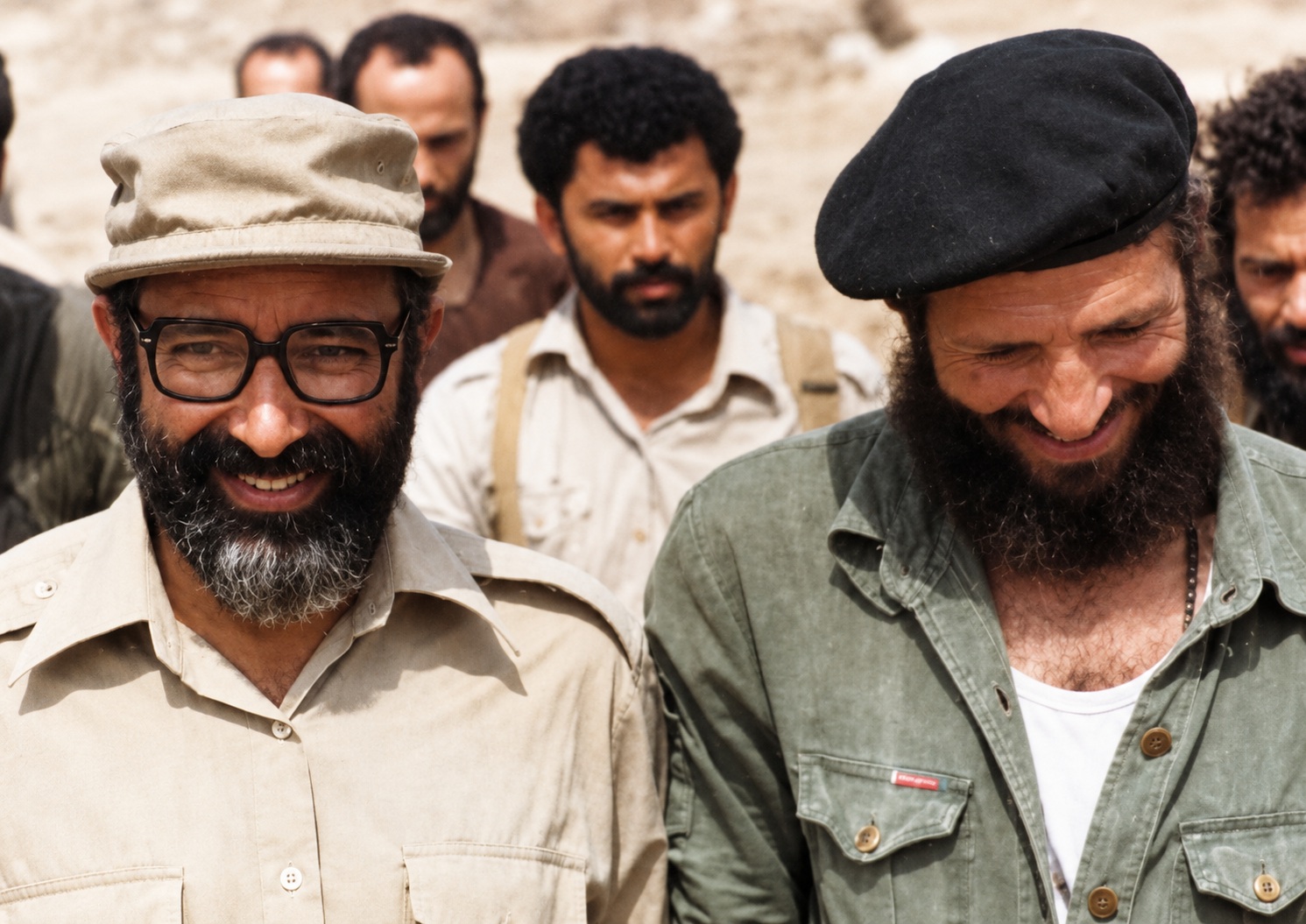
 In May 1985, Seyed Mojtaba Hashemi returned to Tehran to attend to matters behind the front. While fasting for Ramadan, he was shot dead by members of the People's Mojahedin Organization of Iran (MEK) in his clothing shop on Tehran's Vahdat-e Eslami Street.
Hashemi had served in the army's Green Beret special forces. Before the Islamic Revolution, he left the Shah's army and joined the opposition to the monarchy. After the revolution and Ayatollah Khomeini's return to Iran, he joined the committee formed to welcome him.
He volunteered with the Islamic Revolutionary Committee in Tehran's District 9. Before the war, he was active during the unrest in Kurdistan; in Tehran, he confronted the MEK and other counterrevolutionary groups. He met Sadegh Khalkhali after the committee was established. When war broke out, Hashemi drew up a list of men willing to fight. On the second and third days of the war, he assembled them and, in coordination with Khalkhali, set out for the war zone in two buses and several cars. Khalkhali had placed the group under his command. Hashemi traveled south and based his men at the Fadaiyan-e Islam school in Abadan. They became known as the Fadaiyan-e Islam group, an early irregular force formed to resist the invading Baathist troops around Abadan and Khorramshahr.
Accounts put the number of volunteers who joined Hashemi from across Iran at more than 1,500. Any account of popular participation in the war must also remember those who organized it. Hashemi and Mostafa Chamran were the two early commanders of irregular forces who created structures for volunteers before the Basij formally joined units of the Islamic Revolutionary Guard Corps (IRGC) and the IRGC developed its new combat organization. At the time, many volunteers fought through one of these two groups.
At a memorial for Hashemi, commander Mohammad Esmail Kowsari recalled: “When Imam Khomeini called for an army of 20 million, many senior figures asked how that could be possible given the country's population. Two men acted on his call faster than the others: Martyr Chamran and Martyr Hashemi. Hashemi organized large numbers of volunteers at a time when the army and the IRGC found recruitment difficult in the early days of the war.”
The article traces the MEK's hostility toward Hashemi to his revolutionary activities, his opposition to the organization, and his knowledge of its operations. His work with the District 9 committee, it says, curtailed the group's room to operate and recruit supporters in that part of Tehran. He received repeated death threats but did not withdraw.
According to the account, that hostility intensified early in the war. It alleges that MEK members were spying for Iraq in Abadan while Hashemi and the Fadaiyan-e Islam group closely monitored them. The organization was also active in the city, the article says, drawing on equipment and supplies obtained from Iranian forces and captured from Iraqi troops to undermine military and paramilitary groups fighting the Baathists. On several occasions, MEK members allegedly opened fire on the Karavansara Hotel, where the Fadaiyan-e Islam fighters were staying. The men in Abadan thus faced Iraqi forces at the front and attacks from within the city. The article says repeated attempts to assassinate Hashemi during Operation Samen-ol-A'emeh, which broke the siege of Abadan, failed.
The group also harassed Hashemi's family and threatened him in an effort to weaken his commitment to supporting the fighters, according to the article. On May 18, 1985, during Ramadan, he was back in Tehran on business connected to the front when assailants shot him from behind at his clothing shop on Vahdat-e Eslami Street. The account says several MEK members arrived and told him they had traveled a long way and wanted him to open the cooperative shop's shutter and sell them some goods. Unarmed, he let them in. They entered quickly and fired several shots into his back, killing him.
The article argues that one purpose of the assassination was to serve Saddam Hussein shortly before the MEK leader's move to Iraq. It alleges extensive cooperation between the organization and Iraqi intelligence, and notes that records and recordings of their exchanges became public after the fall of Saddam's government. One document, it says, records an MEK liaison reporting Hashemi's killing to Iraqi intelligence.
At a meeting in 1985, Abbas Davari, who often represented the MEK in intelligence exchanges with Baathist Iraq, reportedly said: “I have one or two items of news for you. Yesterday our people in Tehran killed one of the regime's operational commanders. He commanded the Fadaiyan-e Islam operations and was one of the officials with information about the Penjwin garrison.” The article says those details match Hashemi. It interprets the recorded statement as the organization's acknowledgment of responsibility and places it alongside other documents it cites as evidence of the MEK's violent record.