
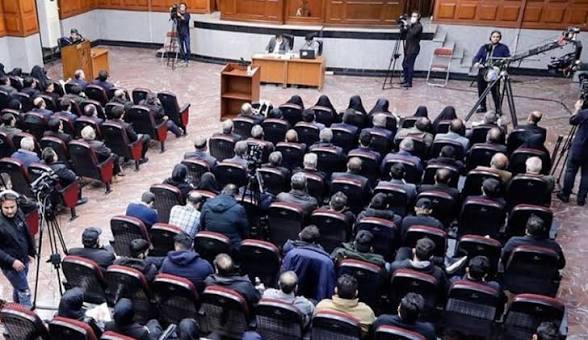
 The 55th hearing in the case against members of the People's Mojahedin Organization of Iran, or MEK, and the organization as a legal entity was held on Tuesday, September 22, 2026, before Branch 11 of Tehran Province Criminal Court One. Judge Amirreza Dehghani presided, with associate judges, a prosecutor's representative, lawyers for the complainants and defendants, families of terrorism victims, and other attendees present.
Opening the hearing, Dehghani called it a major terrorism case convened to uphold rights, examine crimes against victims, and deliver justice. He said the court would resist pressure and attempts to influence public opinion; its decisions would rest on law, documents, and evidence. The allegations concern the MEK as a legal entity and 104 senior members and principal operatives. The case reached Branch 11 after Tehran prosecutors submitted an indictment and the legal steps were completed. The proceedings, he said, were public and formal, with counsel for both sides and the required court officials present.
Court Stresses Defendants' Right to Counsel
Dehghani said every defendant has the right to choose a lawyer under the constitution and criminal procedure rules. If an accused person does not appoint counsel, the court must assign a lawyer to protect their defense rights. The defendants in this case had not named lawyers, he said, so after the statutory deadline the court appointed counsel for them in accordance with the relevant rules.
Responsibilities of States Hosting Terrorism Suspects
Another issue raised at the start of the hearing was the responsibility of states that have allowed MEK members to reside, operate, or claim asylum in their territory.
The court has heard witnesses, former members, and experts, Dehghani said. The international responsibility of states that host or shelter people accused in terrorism cases would be examined under international legal principles, treaties, and domestic laws.
Citing UN Security Council Resolution 1373 and other counterterrorism instruments, he said states must prevent safe haven for people involved in financing, planning, supporting, or carrying out terrorist acts. He also invoked the principle of “extradite or prosecute”: countries where suspects reside should try them under their own laws or extradite them to the country where the alleged offense occurred and a competent court.
Referring to France and Albania, Dehghani said states that allow such suspects to operate must answer for their international obligations. The case would proceed publicly, with lawyers present and legal safeguards observed, he added.
Masoud Maddah, counsel for the complainants, then described the MEK as a terrorist group being prosecuted both as a legal entity and through the alleged roles of 104 senior members and leaders. He accused it of violence against Iranians, citing the killing of civilians, attacks on ordinary people, torture, bombings, arson at hospitals, attacks on civilian facilities, and the Aftab, Chelcheragh, and Forough-e Javidan operations. The court had examined and received documents concerning those allegations, he said.
Rajavi's Statements on the Organization's Activities in the 1980s
To support his characterization of the MEK, Maddah cited remarks by its leader Massoud Rajavi at a 1999 meeting with the head of Iraq's Baathist intelligence service. A video of the meeting was played in court. Maddah said Rajavi discussed the group's activities in the 1980s and that the remarks, recorded in volume 20 of the case file, indicated early support from certain states and awareness of its activities in foreign political circles.
Maddah asserted that the MEK remained on the US terrorist list until 2010 and the EU list until 2005. He also cited the French counterterrorism police's 2003 arrest of Maryam Qajar Azdanlou, known as Maryam Rajavi, on allegations related to terrorist activities. He said that history should be considered when assessing the group's conduct.
“The Organization's Nature Has Not Changed”
Maddah said earlier hearings had compared the MEK's conduct with European counterterrorism laws and that, in his view, it met standards in those laws and international conventions. He argued that the group's survival and its leaders' position had been tied to killing, war, unrest, armed operations, and terrorism.
Referring to 1981, he said some members had described the organization's need for bloodshed to justify an armed campaign against the Islamic Republic. Calls for killing, arming followers, terrorist operations, and insecurity began in that period, he argued, and a change of tools or methods had not altered the group's character.
Cooperation With Baathist Iraq From Intelligence to Direct Operations
Cooperation with Iraq during the Iran-Iraq War was a central part of Maddah's submissions. He described three forms: military cooperation, intelligence work, and direct participation in crimes and operations against Iran.
The organization used Baathist weapons and facilities, he said. It also collected intelligence, intercepted communications, conducted telephone-based intelligence gathering, and passed information about the war to Iraq. Its direct role, he alleged, included the Aftab, Chelcheragh, and Forough-e Javidan operations against Iran and its people.
From Saddam to Alleged Links With the United States and Israel
Maddah argued that the MEK's earlier cooperation with Iraq had continued in the form of ties with other hostile states. Documents alleging cooperation with the United States and the Israeli regime during the 12-day war had been presented at earlier hearings, he said.
After Iran accepted UN Security Council Resolution 598, Maddah said, Massoud Rajavi analyzed the postwar situation, prepared the ground for the Forough-e Javidan operation, and persuaded Saddam to back it. The organization later formed ties with other hostile states, he alleged.
Returning to its more recent activities, Maddah said the group was pursuing its old course with new tools. He pointed to a statement issued by Massoud Rajavi in the early days of the 12-day war and comments by Maryam Rajavi in the European Parliament calling it the beginning of a new chapter. He said the group had urged the West to increase pressure on Iran and supported confrontational measures on the nuclear issue.
Alleged Intelligence Sharing and the Assassination of Nuclear Scientists
Maddah said the court was considering allegations that the MEK supplied foreign intelligence services with information about Iran's nuclear activities and scientists. Earlier hearings had discussed alleged links between such intelligence sharing and the assassinations of nuclear scientists, he said. Some members had themselves spoken about the group's role in providing relevant information, he claimed. Changes in personnel or methods did not, in his view, break the continuity of an organization's alleged cooperation with hostile states and terrorist acts.
“Resistance Units” and New Tools
Maddah also discussed the group's online activity and its so-called resistance units. In recent years, he alleged, the MEK has used digital platforms to project an exaggerated image of its social reach. Lacking a broad popular base, it produces content and images with new technologies to suggest public support, he said. Some people shown in such materials were unaware of how their images would be used, according to Maddah.
From 1980s Manuals to Instructions for Sabotage
Maddah referred to pamphlets the MEK published in the 1980s that, he said, taught armed action and sabotage. They allegedly included instructions to destroy or set fire to public property; in some texts, he asserted, “the enemy” meant ordinary citizens. Changes in the group's methods since that decade did not erase its responsibility, he argued.
Dispute Over Whether New Allegations Fall Within the Indictment
The hearing then turned to whether newer alleged actions were a continuation of the conduct charged in the indictment or separate matters. A defense lawyer argued that events such as the 12-day war required proof of the elements of an offense, the perpetrator, and attribution of the act. The court, counsel said, could not examine matters outside the indictment.
The complainants' lawyer disagreed, saying the indictment covered the MEK's alleged cooperation with hostile states and intelligence agencies, not only Baathist Iraq. He said it mentioned ties with US, Israeli, and Saudi intelligence services and the provision of confidential Iranian information. The prosecutor's representative likewise said cooperation with hostile states and services appeared in the charges and supporting documents. What mattered, the representative argued, was whether conduct formed part of a continuing organized pattern, even as the states and agencies involved changed over time.
A substantial part of the hearing was devoted to former MEK members appearing as witnesses. They described their recruitment, transfer to Iraq, arrival at the organization's camps, and life within its ranks. According to their accounts, they entered after receiving various promises and encountered a reality very different from what they had expected.
Mostafa Beheshti Says Forged Letters Took Him From Home
Mostafa Beheshti, a former member appearing as a witness, said an MEK-linked operative came to his family's home in Shahr-e Rey on October 15, 2001, when he was 16. Carrying two forged letters, the visitor claimed Beheshti's older brother, supposedly working in Turkey, wanted him to go there for a job.
Beheshti said he went along, hoping to see his brother and visit Karbala. He was first taken to Sanandaj, then across mountain routes into Turkey, where MEK supporters received him two days later. Whenever he asked about his brother, they told him he was working and would see him soon. They then took Beheshti to Iraq, saying he could visit Karbala before returning to his brother.
In Iraq, he said, a woman called Parvin, whom he later identified as Zohreh Shafaei, took charge of him. After his visit to Karbala, he was brought to an MEK camp. Hearing people speak Persian made him suspicious, but he was told it was a refugee camp processing his asylum case.
Beheshti said he was later moved to Camp Ashraf and placed in a nearly empty room. Two men, one of them Akbar Moeini, entered, insulted and beat him, and accused him of having been sent by Iran with intelligence. He said he did not even understand their references to “the regime” or “the Guards.” His explanations that he had gone to Turkey to see his brother and had been taken to Iraq were rejected. He alleged that they demanded a written confession that Iran had sent him.
Discovering That the Letters Were False
About 20 days later, Beheshti met his brother at the same facility. His brother told him he had sent no letters to Beheshti or his wife and had never asked him to travel to Turkey. Beheshti said he then realized the letters used to lure him from home were forged.
He said he was subsequently moved into the National Liberation Army and then to other MEK bases. Every day he asked reception staff to let him return to his parents in Iran. Eventually, he approached a female official to request permission to leave. She replied, according to Beheshti, that she could have him put in a vehicle and handed over to Iraqi intelligence.
Chamani's Account From Job Offer to Entrapment
Another former member, identified as Chamani, then testified about his recruitment and the group's activities. In 2000, he said, he was lured by a promised job in a carpet factory, with monthly pay of $5,000 for married workers and $3,000 for single workers. He was taken to Turkey and then Iraqi Kurdistan.
After hours of walking, the group reached another location. Chamani said he had known about the political violence and bombings of the 1980s and was religious, but the prospect of work and income persuaded him. In Iraq, he said, they spent time in a Baghdad detention facility before being transferred to an MEK building.
He lived alongside other members and observed their relationships and conduct. Some later joined various MEK teams and programs, he said. Chamani accused the organization of being adept at manipulating and deceiving people. Despite his own history of service and injury at the war front, he said, he only later understood how he had become trapped.
Accounts of Pressure Inside the Organization
After US forces arrived in Iraq, conditions for members became difficult, Chamani testified. One rainy night he slept beneath a tank and awoke with frostbitten feet. He said some commanders' treatment of members shocked him. His experience of comradeship and sacrifice at the front had taught him to look after fellow fighters; in the organization, he alleged, people acted against one another at commanders' orders to improve their standing.
Chamani said he repeatedly saw people who left come under pressure, heard talk of executing them, and claimed some former members were eventually killed. Life inside the organization, he said, bore little resemblance to the better life and employment he had been promised.
Chamani continued his testimony with further allegations about the group's internal control, meetings, and recruitment practices.
Organizational Meetings as a Means of Control
After joining, he said, he attended meetings known as “Flag,” “Bait,” and “Weekly Cleansing.” Members were pressured through various methods, allegedly to make them comply with the organization's demands and deter them from leaving. At one meeting, Chamani said, he was ordered to do something to prove himself and feared that refusing would bring a large group against him again.
What struck him most, he said, was the repeated use of lies and deception, to the point where members came to believe the falsehoods themselves. He told the court that since 2000 he had felt deprived of his real life, a burden made heavier by his children's complaints. Recalling his own experience of sacrifice during the Iran-Iraq War, he spoke of being asked by a cultural official how he had distanced himself from the friends and fallen comrades with whom he had fought. He said he had come to court to describe what happened to him and lodge a complaint against Massoud Rajavi, Maryam Qajar, and other MEK leaders.
Online Propaganda and Links to “Resistance Units”
The court also examined MEK online activity and its alleged contacts with people inside Iran. An expert identified as Sadeqat urged a close inquiry into how individuals connect with “resistance units,” how they are recruited, who intermediates, and what assignments they receive. Investigators should establish when links began, who took part, how they communicated, and what actions actually occurred, he said. Claims about online contacts, videos, reports, and propaganda also required checking for accuracy and detail.
Recruitment of Teenagers and Use of Unwitting Children
The hearing then considered allegations about involving minors. Asked how the units select targets and recruit people under 18, Chamani described a 13-year-old schoolboy in Darab, Fars province. He alleged that people linked to the network recruited the boy to write slogans on a school wall, leading to his identification and arrest and the summoning of his family. The family, he said, thought its money paid for internet credit, while it was used to buy materials for the graffiti.
Chamani further claimed that children who worked for a living were used in propaganda images and content. Some could not read and did not understand the text given to them. Children were sometimes invited to events such as birthday parties and photographed for material later published by MEK-linked outlets, he said, without knowing how their images would be used.
From Initial Deception to Testimony in Court
The former members' accounts formed a major part of the 55th hearing. Alongside the legal arguments, their testimony addressed recruitment, internal practices, and propaganda methods. The court said it would continue hearing witnesses, former members, and experts and examining the available documents.