
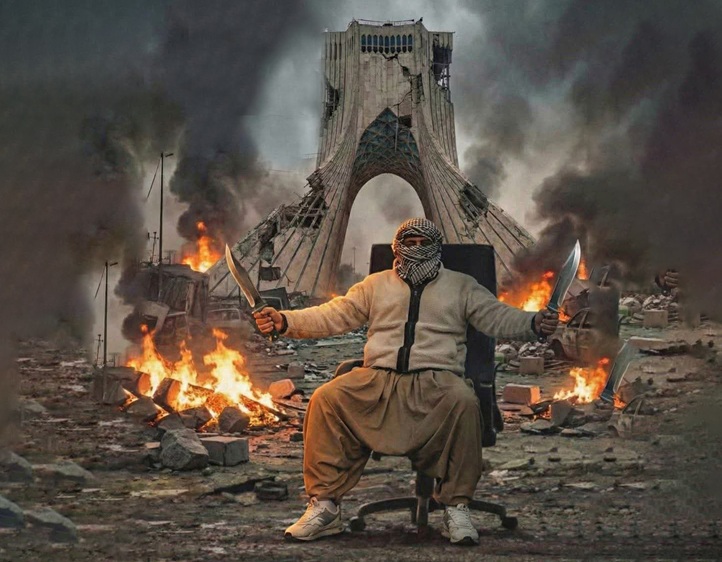
 In recent days, terms such as "terrorism," "terrorist actions," and "terrorist groups" have been frequently used in the political and media discourse of the country. The utilization of these concepts is not merely for psychological operations or political exploitation; rather, the realities unfolding on the ground indicate that what has transpired is an unprecedented and blatant violence employing various intimidation tactics.
The unprecedented scale of attacks using both firearms and melee weapons against the people and security forces, the burning and mutilating of bodies in public, decapitations, destruction of public property such as streets, public transport, ambulances, and hospitals, as well as assaults on individuals and their homes with threats, beatings, and even killings, along with widespread arson of shops and vehicles, constitute some of the extremely violent and unprecedented actions that have occurred recently in various cities across the country. Intriguingly, these events bear resemblance to the bitter incidents of the 1980s, perpetrated by various armed groups and terrorists such as the Mojahedin-e Khalq (MEK) and armed separatist groups in different regions of Iran.
In fact, even setting aside the unprecedented and overt support of hostile foreign governments (the U.S. and Israeli regime) for the rioters and intimidators, and the guidance of actions against national security from beyond the borders, the actions committed in recent days can legally be classified as terrorist acts or actions equivalent to them.
Although the term "terrorism" and its precise equivalent were not common in the early Islamic era and its legal frameworks, there are expressions in the Quran and the hadith legacy of Muslims and jurists that closely resemble the current concept of terrorism. Terms such as "moharebeh" (waging war), "baghy" (rebellion), "fatk" (assassination), and "ghetal" (murder) bear significant similarities in content and meaning to the term terrorism. These concepts encompass elements such as acts of violence, instilling fear and panic, the use of weapons, and the disruption of public order and security; thus, they are considered equivalent to terrorism by some.
In the definitions provided by jurists, "moharebeh" refers to displaying weapons with the intent to instill fear among the populace, and someone who engages in such actions is termed a "mohareb." They cite Quranic verses (such as verse 33 of Surah Al-Ma'idah) to prescribe death or exile as punishment for such individuals. "Baghy," or rebellion, refers to insurrection against the legitimate ruler and the community's leadership, with those committing it being labeled as "baghi." Some jurists have declared these rebels as infidels, while others see them as corrupt. In Iran's Islamic Penal Code, punishments such as death and imprisonment are designated for such individuals. In fact, when explaining the concept of "moharebeh" in contrast to concepts like "baghy," it should be noted that "moharebeh" involves fighting and intimidating the populace, whereas "baghi" seeks to wage war against the community's ruler. These two concepts, according to political thinkers and scholars of political jurisprudence, differ from the notion of civil disobedience. Some of these scholars argue that civil disobedience or resistance is aimed at changing a law or reforming a policy or decision, rather than overthrowing the political system or instilling fear among the public. In other words, civil disobedience is the peaceful protest of the people or segments of society and does not equate to "baghy" or "moharebeh."
The emphasis on separating those protesting against economic mismanagement from individuals and groups that, in recent days, have created an unprecedented wave of insecurity and killings through the use of various weapons and terrifying actions is crucial. Numerous clear examples of "baghy" and "moharebeh" have occurred in recent days, including the slaughter of innocent people—from passersby to protesters, sweepers, and nurses, as well as the killing of security personnel and attempts to seize government and law enforcement facilities—encompassing both concepts together.
Thus, the use of the term terrorism to describe recent tragic events is not an abstract issue. Now, even if we set aside the direct presence of recognized terrorist groups and their statements supporting the chaos and armed conflict, along with explicit and concentrated foreign backing, what transpired in our country was nothing but the presence of groups, gangs, and individuals engaged in terrorism and using terrifying methods. Therefore, it is expected that the judicial system's response to the arrested terrorists aligns with anti-terrorism laws or similar legal frameworks.