
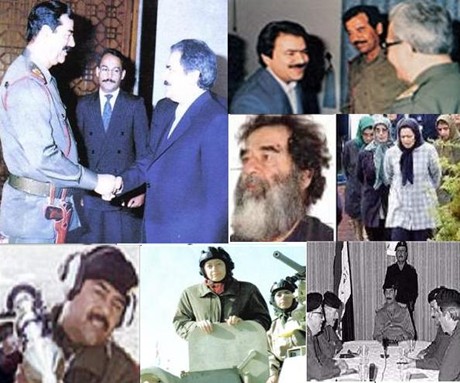
 During its eight-year war against Iran, the Ba'athist regime of Iraq used every tool and relationship—including the MEK terrorist group—to commit crimes.
The Ba'athist regime launched its military aggression against Iran on September 22, 1980 (31 Shahrivar 1359), with the illusion of occupying parts of Iranian territory. As the war continued and Saddam realized the mirage of his ambitions, he extended a helping hand to Iran's enemies.
In addition to countries hostile to Iran—who viewed Saddam's already doomed war as an opportunity to advance their own hostility—the Ba'athist regime cooperated with the MEK terrorist group.
This sinister cooperation between the Ba'athist regime and the MEK was a coordinated but ultimately failed effort by two terrorist entities that shared a common enmity toward Iran.
The cooperation was so extensive that Saddam personally met and negotiated with Massoud Rajavi, the leader of the MEK terrorist group, and ordered senior Iraqi army officials to provide all kinds of cooperation to the group.
Although mercenarism is a well-known characteristic of the MEK, one cannot overlook Saddam's expectations of this displaced group to achieve his illusory anti-Iranian goals. The MEK played an undeniable role in encouraging Saddam to take action against Iran.
The reality is that Saddam, considering a relationship that had lasted two decades—beginning with granting refuge to the MEK after they fled Iran following the Islamic Republic's confrontation with their terrorist activities—pursued specific objectives. From this perspective, Saddam's seizure of land belonging to Iraqi tribes in Diyala Province and handing it over to the MEK in 1986 (leading to the establishment of Camp Ashraf) was not merely an act of sheltering a group of displaced terrorists at war with their own country.
Just as Massoud Rajavi nurtured illusions of power in Ashraf, Saddam sought to exploit the group further.
According to documents and videos discovered after Saddam's fall, MEK representatives repeatedly met and negotiated with senior officials of Saddam's security apparatus. These meetings ultimately led to the MEK's official mercenarism for the Ba'ath Party.
In exchange for receiving several barrels of oil, the MEK agreed to gather intelligence from the war fronts and hand it over to the Ba'athists. Their efforts to obtain this intelligence moved their cooperation with the Ba'athists into a new phase: creating fear and terror inside Iran through terrorist actions, psychological operations, and rumor-mongering.
Repeated failures in realizing their anti-Iranian illusions on the war fronts led both Saddam and Rajavi into a shared delusion of power. While Rajavi formed what he called the "National Liberation Army" in Ashraf to pursue his anti-Iranian illusions through terrorism, Saddam thought of using their limited capabilities as infantry for operations inside Iranian territory.
The result of this thinking was the failed and illusory operations: "Aftab" on March 28, 1989 (8 Farvardin 1368), aimed at capturing Fakkeh; "Chelcheragh" on June 18, 1988 (28 Khordad 1367), aimed at capturing Tehran; and "Eternal Light" on July 25, 1988 (3 Mordad 1367).
The MEK terrorist group—the fifth column of the Ba'athist regime of Iraq during the war against Iran—committed numerous military and non-military betrayals against our country.
Shadab Asgari, a researcher and writer on contemporary history and the Sacred Defense, said in an interview with Mizan News Agency that after Operation Muharram in 1982 (1361), Operation Val Fajr Moghadamati was launched but unfortunately did not achieve the desired results. Later it became clear that the MEK had passed information to the Iraqi side. From that year until the end of the imposed war, they were fully at Saddam's service and carried out domestic assassinations and bombings.
This expert on contemporary history emphasized that the MEK has no attachment to Iran: "There was no crime they would not commit for Saddam. The dimensions of the MEK's crimes are extremely broad. This group also carried out Operation Pearl against Iraqi Kurds and unleashed a horrific massacre."
Considering all the above, the relationship between Saddam and the MEK terrorist group during the imposed war was not one-sided or one-dimensional. From one perspective, the MEK engaged in mercenarism for Saddam in exchange for money, while Saddam extended a hand of cooperation to the MEK to escape defeat.
a