
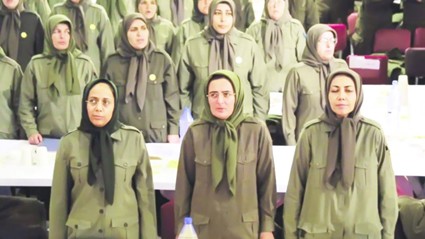
 The Mujahedin-e Khalq Organization, as a terrorist group that has played a destructive and combative role in Iran’s political developments over past decades, claims in its propaganda to defend women’s rights and freedoms. However, numerous pieces of evidence and narratives from defected members and theoretical analyses show that the position of women in this organization not only does not align with concepts of freedom and independent identity but, in a paradoxical way, serves the ideological and repressive goals of the leadership. This article, drawing on the views of Herbert Marcuse, philosopher of the Frankfurt School, and analyses of narratives from women who left the cult, examines the status of women in the Mujahedin’s organizational relations. The results show that women in this organization have been turned into one-dimensional beings stripped of human emotions, feminine identity, and natural roles, becoming mere tools for realizing the violent and absolutist ideals of the ideological leader.
Introduction
The Mujahedin-e Khalq Organization, founded in 1965 by Mohammad Hanifnejad, Saeed Mohsen, and Asghar Badizadegan, adopted an ideological and combative approach initially inspired by revolutionary Islam and later shifting toward Marxism. After the 1979 Islamic Revolution and following its failure to gain a social base, the organization turned to terrorist activities. In subsequent decades, with its establishment in camps such as Ashraf and later in Albania, it transformed into a closed and absolutist cult.
In this context, the presence of women in the organization — which began in 1969 — became one of the focal points of the leaders’ propaganda, especially Masoud and Maryam Rajavi. They tried to portray themselves as defenders of women’s rights with slogans such as “women’s hegemony” and “woman, resistance, freedom.” But the internal realities of the organization, revealed through the memories and revelations of defected women such as Batoul Soltani, Nasrin Ebrahimi, and Marzieh Ghorshi, present a completely contradictory picture. This article, utilizing Herbert Marcuse’s theoretical framework and the concept of “one-dimensional man,” analyzes the situation of women in the Mujahedin organization and raises the question of how the organization’s absolutist ideology and repressive relations have deprived women of their human identity and individual independence.
Theoretical Framework: Marcuse’s One-Dimensional Man and Ideological Critique
Herbert Marcuse, the prominent philosopher and sociologist of the Frankfurt School, argues in his book One-Dimensional Man (1964) that repressive systems — whether in the form of modern capitalism or authoritarian ideologies — reduce human beings to one-dimensional entities deprived of critical thinking, freedom, and transcendent emotions. According to Marcuse, this repression occurs under the guise of meeting material and welfare needs, but in reality, it traps humans in a cage of obedience and dependence. This theoretical framework is highly insightful for analyzing the status of women in the Mujahedin organization, as it shows how the organization’s ideology, by eliminating the human and emotional dimensions of women, has turned them into mere tools in the service of the leadership’s goals.
The Position of Women in the Mujahedin Organization: From Cover Tool to Ideological Slavery
1. The beginning of women’s presence: Women’s entry into the Mujahedin organization from 1969 was not based on a belief in gender equality but as a tool to provide cover for men’s activities against SAVAK. Women such as Pouran Bazargan and Leila Zomorrodian were used as “cover elements” to reduce security sensitivities. This instrumental approach from the very beginning indicated a contemptuous view of women, in which they were seen not as independent actors but as auxiliary means.
2. Organizational marriage and deprivation of choice — In various periods, including after the shift to Marxism in the 1970s and during Masoud Rajavi’s leadership, marriage in the organization came under complete control of the central leadership. Forced marriages and imposed divorces, such as the separation of Maryam Qajar Azdanlou from Mehdi Abrishamchi and her marriage to Masoud Rajavi under the title of “ideological revolution,” are clear examples of the deprivation of women’s choice. These actions not only disregarded women’s human dignity but turned them into pawns in a power game.
3. Suppression of feminine and maternal identity — One of the most prominent features of Mujahedin relations is the systematic suppression of feminine, maternal, and romantic feelings. The prohibition of marriage and family formation, forced separation of women from their children, and continuous psychological pressure through “self-criticism” sessions have turned women into beings devoid of human emotions. Narratives such as Batoul Soltani’s memories of the “dance of liberation” and humiliating ceremonies under the supervision of Masoud and Maryam Rajavi show the leadership’s deliberate effort to sexually and psychologically exploit women.
4. Use in terrorist operations and violence — Women were used as executive tools in terrorist operations of the 1970s and 1980s, such as the assassination of Majid Sharif-Vaqefi with the help and accompaniment of his wife Leila Zomorrodian. This role, which contradicts slogans of “women’s liberation,” indicates the exploitation of women for the organization’s violent goals. In fact, women not only did not gain freedom but were turned into armed slaves who had to act in the service of the absolutist ideology.
Ideological Analysis: Absolutism and Negation of Critical Rationality
The leaders of the Mujahedin, especially Masoud Rajavi, with reliance on a medieval and absolutist worldview, denied any historical transformation and critical rationality. They refused to accept democratic principles and human rights by emphasizing the unchanging essence of concepts and values. This attitude is clearly visible in their treatment of women: women in the organization are regarded as beings without independent identity who must be placed on the path of blind obedience and violent operations. This absolutism, in Marcuse’s terms, has deprived humans of their multi-dimensional capacities and turned them into one-dimensional and obedient beings.
Narratives of Defected Women: Testimony to Repression and Exploitation
The memories and revelations of women such as Batoul Soltani, Nasrin Ebrahimi, and Marzieh Ghorshi reveal the dark dimensions of Mujahedin relations. Soltani speaks of “dance of liberation” ceremonies in which women were forced into sexual and psychological submission to Masoud Rajavi. Ebrahimi and Ghorshi also point to the suppression of maternal and emotional feelings and emphasize that the cult’s leadership deliberately stripped women of their human identity. These narratives confirm that women in the organization not only do not enjoy freedom but live in conditions similar to modern slavery.
The Paradox of Slogan and Practice: Human Rights Displays Versus Reality
While the Mujahedin, in their external propaganda — especially in ceremonies such as International Women’s Day — exploit the presence of international figures to build a human rights image, the internal reality of the organization is completely contradictory. Inviting figures such as Ingrid Betancourt and Michèle Alliot-Marie at exorbitant costs and with luxurious trips to Paris is an effort to hide the violation of women’s rights within the organization. This contradiction shows that the group’s freedom-seeking slogans are merely tools to attract foreign support and have no relation to the real experience of organizational women.
The Frankfurt School and Broader Critique of Cultism
The Frankfurt School generally views cults as microcosms of social domination in which cultural and psychological control replaces overt force. Adorno and Horkheimer, in Dialectic of Enlightenment, argue that cultural tools (such as propaganda or cult ceremonies) can drive people to accept voluntary slavery. In the case of the Mujahedin, ceremonies like the “dance of liberation” or extensive propaganda on International Women’s Day are used as tools to legitimize internal repression, while the reality behind the scenes is exploitation and humiliation of women.
Conclusion
Examining the position of women in the Mujahedin organization shows that, contrary to its claims, this organization is not only not a defender of women’s rights but has engaged in their exploitation and enslavement by suppressing their human and feminine identity. From Marcuse’s perspective, women in this cult have been turned into one-dimensional human beings deprived of transcendent emotions, independence, and critical thinking. The leadership’s absolutist and violent ideology, along with repressive relations, has turned women into tools for terrorist and political goals. However, the gradual rebellion of defected women and their revelations herald the future collapse of these misogynistic barriers. It is suggested that further research be conducted on the psychological and social impacts of these relations on women so that the full dimensions of this human tragedy can be clarified.
By Arash Rezaei